July 30, 2026 · 6 min read
Spec-driven development with AI: what actually broke
- ai
- architecture
- process
I am building a platform for a steel supplier: a multilingual catalogue with a custom price-management engine, dated price history with trend charts, and a small CRM for sales leads. Next.js and Payload on MongoDB, self-hosted behind Caddy.
I am building all of it with Claude Code as the primary interface, not as an autocomplete I occasionally accept. This post is about how that actually went, which is to say: about the two things I got wrong and what they taught me. Partly a reference for future me, partly because every post I read about AI-assisted development stops at "it made me faster" and none of them mention what it does to the parts of the job that are still yours.
Spec first, because generation is no longer the bottleneck
Before any code, I wrote an architecture document, a data model, nine architecture decision records, a milestone roadmap, and an operations runbook. That sounds like a lot of ceremony for a brochure site with a pricing feature. It is not ceremony; it is where the work moved to.
The reason is simple. When implementation was expensive, it made sense to think a little and code a lot, discovering the design by writing it. Now implementation is close to free, and the constraint has moved upstream. The AI will faithfully build whatever I describe, at speed, including a design that does not survive contact with the domain. So the specs are not documentation of the work. They are the work.
The ADRs turned out to be worth more than I expected, for a reason I did not anticipate: they are stable context. A decision recorded with its reasoning stops getting relitigated in later sessions. Without them, every fresh context window is an invitation to redesign something that was already settled for good reasons I could no longer remember either.
What broke, first: the domain model
Steel pricing looks trivial until you look at it. My first model put price on the product:
// Wrong. Cannot represent reality.
type Product = {
  title: string;
  currentPrice: number;
  currency: string;
};
That model cannot express any of the four cases the client actually has: a product with no price at all, a product priced only on request, a product with a single price, and a product with a table of prices from different producers, each with its own attributes and its own history to chart.
So I split pricing out, and got it wrong a second time. I put free-form attributes on each price row, which meant every row for the same product could drift, and nothing owned the definition of the table columns.
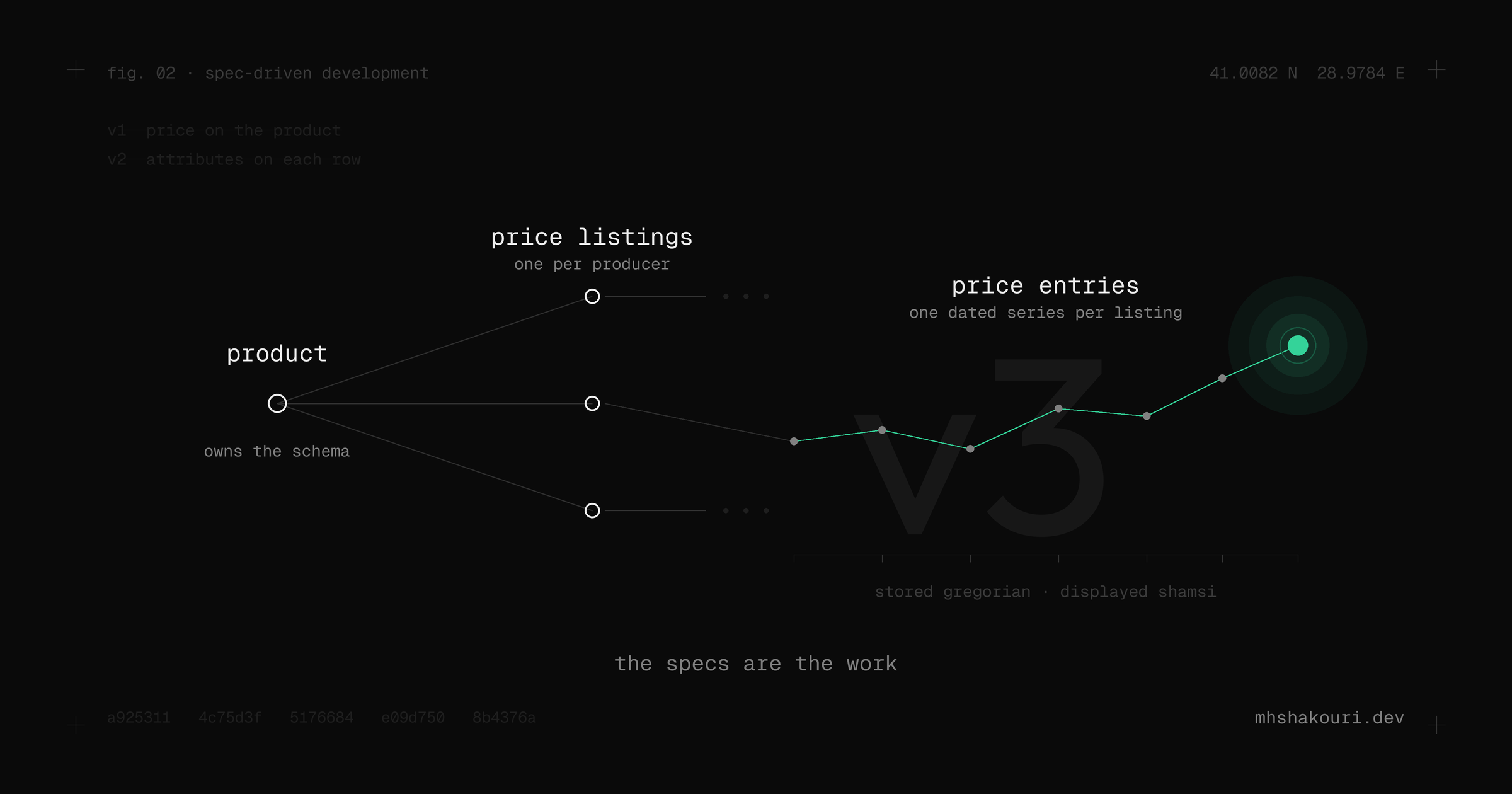
The shape that finally worked has three levels:
// The product owns the schema: what columns its listings must have.
type Product = {
  title: string;
  priceAttributes: { key: string; label: string; required: boolean }[];
};

// A listing is one offering: a producer, with values for that schema.
type PriceListing = {
  product: Product["id"];
  priceType: "priced" | "callOnly";
  currency: string;
  attributeValues: { key: string; value: string }[];
};

// An entry is one dated price. The series is the history and the chart.
type PriceEntry = {
  listing: PriceListing["id"];
  price: number;
  date: string;
};
Both times, the AI built my wrong model correctly and quickly. It did not hesitate, and it did not ask whether the model matched the business. Why would it? It had a specification and it met it.
That is the part worth internalizing. A tool that removes the cost of implementation also removes the friction that used to make you notice a bad design. Writing three hundred lines by hand for a model that feels awkward is itself a signal. Getting three hundred correct lines in twenty seconds is not.
What broke, quietly: calendars
The client thinks in the Shamsi calendar, so I stored Shamsi dates. Every comparison, every sort, every chart aggregation then had to go through conversion, and the bugs it produced were the annoying kind: not crashes, just wrong ordering.
The fix is the boring one. Store Gregorian days internally, normalized to the Tehran day so a price entered at 1am lands on the correct local date, and convert to Shamsi only at the edges for display. Charts read the internal dates and format the axis labels.
No AI involvement in that mistake at all. I made it before the specs, in the part of the design where I was being considerate rather than careful.
The one thing AI could not shortcut
The price attributes are dynamic per product, but CMS fields are defined statically in code. So there is no built-in way to render the right labelled inputs for whichever product an editor has selected. That needs a custom admin component that reads the product's schema at runtime and builds the form from it.
I could have shipped a generic key-value input in an afternoon. I decided not to, because entering prices is the client's daily task and a bad form is a bad product, and instead opened that work with a short throwaway spike to confirm the framework's component APIs behave before committing to the real implementation.
That decision has nothing to do with AI, and that is precisely the point. Knowing which corner is worth cutting is not a thing the model has an opinion about.
What I actually changed about how I work
Be precise about the problem, because the AI will be precise about the solution. Nearly all of my failures on this project were specification failures, not generation failures.
Write the reasoning down, not just the decision. ADRs are context that survives a session boundary.
Use AI to review AI. Having it check its own output against the spec catches a real share of issues before I run anything.
Own the domain model personally. It is the one place where being wrong is expensive and the model cannot save you, because it has no way to know the business.
Ship earlier than feels comfortable. Rework is cheap now. Discovering the model is wrong against real usage beats trying to be right on paper.
Where this lands
I have shipped more in the last month than in any comparable stretch of my career, and I have also written more specification than in any comparable stretch. Those two facts are the same fact.
The generation was never the hard part. It just used to be slow enough that it felt like the job.